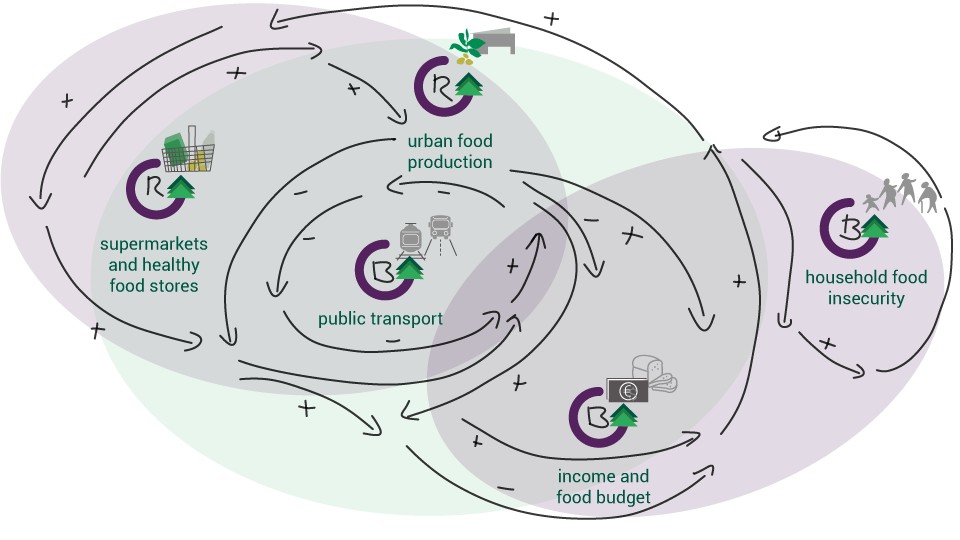
The Spatial Food Systems Model (SFSM) describes how a city’s built environment, household economics, and food retail dynamics jointly produce — or prevent — food insecurity. Its logic is captured in five feedback loops: three balancing loops that stabilize the system, often at the expense of the most vulnerable, and two reinforcing loops that can build momentum toward a healthier food environment. The system dynamic model is grounded in the food-environment literature and extends the qualitative system map into an executable simulation model: every loop is backed by stocks, flows, and equations, and every stock — supermarkets, fast-food outlets, transit stations, urban farms — is a countable element of the real city, linked to GIS data.
The Five Feedback Loops
The model centers on two major system functions: Self-regulating (balancing - B) dynamics that attempt to stabilize food access in response to external stress and self-reinforing (positive feedback - R) dynamics that, when initiated, can rapidly expand access to and demand for healthy food in the local environment. The model captures the local urban food environment well, but leaves upstream, macroeconomic and individual behaviour feedback outside the structure. The SFSM links built environment, household resources, and household circumstances to test policy scenarios. It is strongest for comparing interventions, understanding system response, and identifying leverage points.
Balancing Feedback Loops
Public transport
When healthy food is scarce locally, people must shop elsewhere — and that need creates pressure on policymakers to improve public transport. Better transit lowers the time and mobility barriers to reaching food, which improves accessibility and, indirectly, local availability. B1 is a balancing loop: it can stabilize food access when local conditions deteriorate, but only if transport policy actually responds. Levers: transit affordability and station density in underserved areas, extended retail hours, food retail near transport nodes.
Income and food budget
Rising living costs shrink the food budget. A tighter budget lowers willingness to pay for healthy food, demand falls, retailers stock less of it or close — and residents must travel further and pay more, which strains budgets further. B2 shows how the system “balances” itself by cutting healthy food consumption rather than fixing incomes. Levers: food affordability programs, income support, reducing housing and utility costs, strengthening purchasing power.
Household coping
Under food stress, households adapt: cheaper calorie-dense food, smaller portions, skipped meals. These strategies relieve the budget in the short term — and damage health in the long term, feeding diet-related disease and deeper vulnerability. B3 is the survival loop of food insecurity: self-stabilizing, but at the cost of wellbeing. Levers: food assistance and cost-of-living relief, affordable healthy food in underserved areas, integrating food security into health and social services.
Reinforcing Feedback Loops
Urban food production
Urban farming e.g. community gardens, rooftop farms, vertical farms or greenhouses increase local availability of fresh food. Better availability enables health-driven purchases, raises willingness to pay, shifts perceived affordability, and builds market pressure for more local production. R1 is a reinforcing loop: once started, it amplifies itself — if initial barriers of land access, startup costs, and zoning are cleared. Levers: access to growing spaces, incentives for community food initiatives, food education.
Supermarkets and healthy food stores
More supermarkets and healthy food stores mean more available healthy options; availability drives health-determined purchases and demand, and growing demand attracts further retail investment. R2 can transform food deserts and food swamps into food-secure neighbourhoods — but in underserved areas, market forces rarely start the loop on their own. Levers: public investment to seed retail in underserved areas, affordable and culturally appropriate offerings, partnerships between city, retailers, and communities.
Publications
Transitions to food democracy through multilevel governance
Food systems in Europe are largely unjust and not sustainable. Despite substantial negative consequences for individual health, the environment and public sector health and care services, large multi-national corporations continue to benefit from the way food systems are designed—perpetuating “Lose–Lose–Lose–Win” food systems that see these large corporations benefit at the expense of health, the environment and public sector finances.
An approach to cluster the research field of the food-energy-water nexus to determine modeling capabilities at different levels using text mining and cluster analysis
The global demand for resources such as energy, land, or water is constantly increasing. It is therefore not surprising that research on the Food-Energy-Water (FEW) nexus has become a scientific as well as a general focus in recent years. A significant increase in publications since 2015 can be observed, and it can be expected that this trend will continue.
Using 3D CityGML for the Modeling of the Food Waste and Wastewater Generation—A Case Study for the City of Montréal
The paper explains a workflow to simulate the food energy water (FEW) nexus for an urban district combining various data sources like 3D city models, particularly the City Geography Markup Language (CityGML) data model from the Open Geospatial Consortium, Open StreetMap and Census data. A long term vision is to extend the CityGML data model by developing a FEW Application Domain Extension (FEW ADE) to support future FEW simulation workflows such as the one explained in this paper.
On the design of an urban data and modeling platform and its application to urban district analyses
An integrated urban platform is the essential software infrastructure for smart, sustainable and resilient city planning, operation and maintenance. Today such platforms are mostly designed to handle and analyze large and heterogeneous urban data sets from very different domains.
Using 3D CityGML Models for Building Simulation Applications at District Level
The paper analyses the potential of 3D CityGML geometry models for building heating demand simulation. Various aspects of processing 3D data to make it suitable for building simulation are discussed.